
Is Your Commercial Roof Costing You More Than It Should?
Picture this: It’s mid-July in Missouri, and your facility manager gets a call about a water stain spreading across the warehouse ceiling. The HVAC system is working overtime. And then comes the estimate—tens of thousands of dollars to tear off and replace the aging membrane roof. Sound familiar?
It’s a scenario our team at Show Me Coatings has walked into dozens of times across Missouri and Iowa. And more often than not, a well-timed roof coating system could have prevented every bit of it. The roof was structurally sound. It just needed the right protection.
In this post, you’ll learn what roof coatings actually are, why the benefits of roof coating go far beyond “leak prevention,” and how the right coating system can fundamentally change the performance and cost trajectory of your commercial or metal roof — without shutting down your operations for a full replacement.
What Is a Roof Coating?
A roof coating is a fluid-applied monolithic membrane that adheres directly to an existing roof surface—forming a seamless, fully bonded protective layer. Once cured, it becomes the topmost barrier against weather, UV radiation, thermal stress, and moisture infiltration.
Unlike traditional roofing materials applied in sections, a coating eliminates the seams and laps where leaks most commonly originate. It’s not paint. It’s not a patch. It’s a performance system.
The most commonly used formulations in commercial applications include:
| Coating Type | Best For | Key Strength |
| Elastomeric (Acrylic) | Flat/low-slope roofs | UV resistance, flexibility |
| Silicone | Ponding-water-prone roofs | Water resistance, longevity |
| Polyurethane | High-traffic roofs | Abrasion resistance |
| Aluminum-based | Metal roofs | Reflectivity, rust inhibition |
| Fabric-reinforced systems | Roofs with existing cracks | Structural reinforcement |
At Show Me Coatings, we work with fabric-reinforced and elastomeric systems engineered to resist cracking, splitting, and long-term substrate movement—because heartland weather demands more than a standard coating spec.
Why the Benefits of Roof Coating Matter More Than Most Building Owners Realize
The commercial roofing industry has long defaulted to full replacement as the solution to aging roofs. But that approach carries a hidden cost most property managers don’t fully account for: operational downtime, landfill waste, disruption to tenants, and capital expenditure that could have been deferred by a decade or more.
The benefits of roof coating address all of these pain points — and several that don’t show up on a standard roof inspection report.
“A quality roof coating doesn’t just protect what’s there — it resets the clock on an asset you’ve already invested in.”
When a structurally sound roof is coated correctly, you’re not just stopping a leak. You’re restoring membrane performance, improving thermal efficiency, and extending the serviceable life of the entire system. For a 20,000 sq. ft. commercial roof, that difference can represent a six-figure decision.
5 Key Benefits of Roof Coating for Commercial Buildings and Metal Roofs
1. Dramatically Extended Roof Lifespan
One of the most immediately quantifiable commercial roof coating benefits is lifespan extension. A professionally applied coating system can add 10 to 20 years to a roof that still has sound structural integrity — delaying or eliminating the need for a costly tear-off replacement.
Metal roofs, in particular, benefit enormously from this. Exposed metal panels are vulnerable to galvanic corrosion, oxidation at fastener points, and thermal cycling fatigue that causes seam separation over time. Roof coating for metal roofs seals those vulnerabilities at the substrate level, encapsulating the metal and halting the degradation cycle before it becomes a structural problem.
Our team has restored metal roofs across agricultural, industrial, and retail facilities in Missouri, where the alternative — a full panel replacement — would have run three to five times the cost.
2. Measurable Energy Savings Through Reflective Roof Coating Technology
Reflective roof coating is one of the highest-ROI modifications a commercial building owner can make to their mechanical systems — without touching a single HVAC unit.
Cool roof coatings, particularly white elastomeric and silicone formulations, reflect solar radiation rather than absorbing it. The U.S. Department of Energy’s ENERGY STAR program recognizes qualifying roof coatings for their ability to reduce rooftop temperatures by up to 50–60°F compared to uncoated dark surfaces. That translates directly into reduced cooling loads and lower utility bills—particularly significant for large-footprint commercial buildings in Missouri’s warm summers.
This is what the industry refers to as energy-efficient roofing: not just good materials, but materials engineered to interact with the climate in a measurable way.
3. Superior UV Roof Protection That Prevents Premature Aging
Uncoated commercial roofing membranes — whether TPO, EPDM, or modified bitumen — absorb ultraviolet radiation daily. UV exposure breaks down polymer chains in the membrane, causing brittleness, micro-cracking, and eventual delamination. This process accelerates in climates with high solar exposure or temperature swings, like the Missouri/Iowa corridor.
UV roof protection through coating essentially sacrifices the coating layer — which is designed to be recoatable — rather than the underlying membrane. When the top coat shows wear, it can be recoated. The membrane beneath remains intact.
This is a fundamentally different maintenance model than what most building owners inherit: instead of waiting for failure and reacting, you’re maintaining a sacrificial layer that can be renewed without disruption.
4. True Waterproof Roof System Performance — No Seams, No Weak Points
Traditional roofing systems fail at their seams. Lap joints, flashings, penetrations, and termination points are the source of the overwhelming majority of commercial roof leaks. A fluid-applied waterproof roof system eliminates this vulnerability by nature of how it’s applied — as a continuous membrane.
On flat and low-slope roofs, where water movement is slow, and ponding is a genuine risk, this seamless application isn’t a luxury — it’s a necessity. Silicone-based coatings, for instance, are engineered to perform in sustained ponding water without degradation.
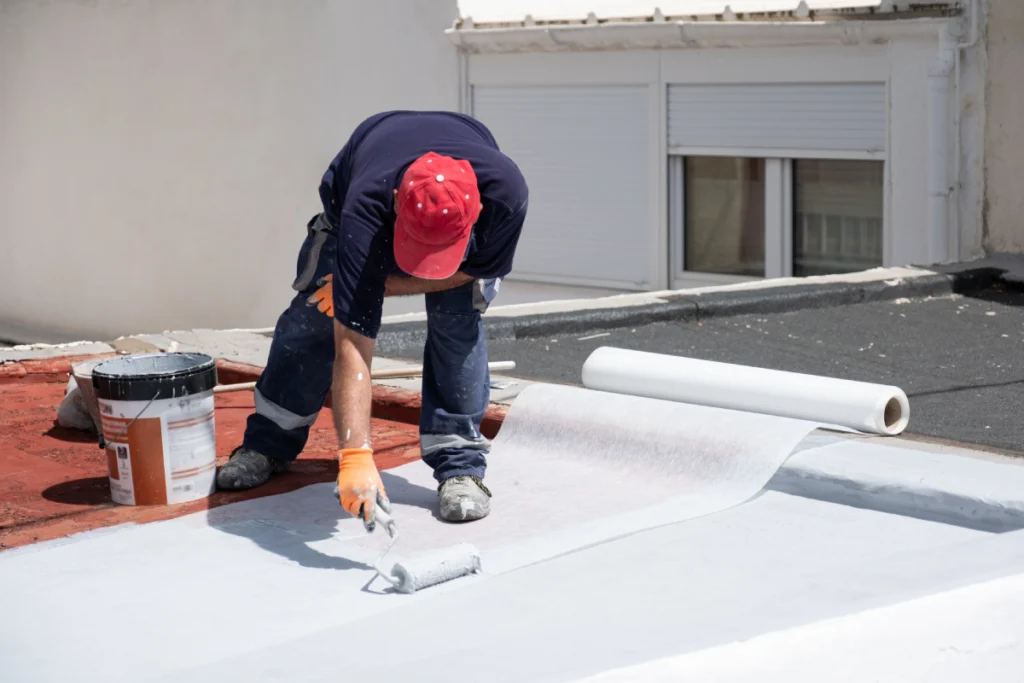
At Show Me Coatings, we use full fabric-reinforced systems on roofs where existing cracks or seam separation require mechanical bridging — not just a coating layer, but an embedded fabric matrix that reinforces the surface before the coating is applied over it.
Explore how this works on our Metal Roof Restoration service page.
Protect Your Roof Before the Next Storm — Get a Free Estimate
5. Elastomeric Roof Coating Advantages: Flexibility That Roofs Actually Need
One of the most underappreciated elastomeric roof coating advantages is elongation — the ability of the cured membrane to stretch and return to its original shape without cracking. Metal roofs expand and contract with temperature changes, sometimes significantly across seasons. A rigid coating system will crack at those stress points. An elastomeric system moves with the roof.
High-quality elastomeric formulations can elongate 100–300% before failure, which means they accommodate substrate movement that would rupture a conventional sealant or patch. For metal roof restoration, this characteristic isn’t optional — it’s load-bearing to the performance of the entire system.
Common Mistakes Commercial Property Owners Make With Roof Coatings
Applying coating to a roof that needs substrate repair first. A coating is not a structural repair. If there is active delamination, rot, or significant moisture entrapped in the existing assembly, coating over it traps the problem rather than solving it. A proper inspection—including an infrared or nuclear moisture scan — should precede any coating decision.
Choosing the wrong coating type for the substrate. Silicone over a surface that needs primer adhesion, or acrylic on a roof with chronic ponding water — these mismatches cause premature failure and give coatings an undeserved reputation for underperformance.
Underestimating surface preparation. Coatings are only as good as the bond they form. Contaminated, oily, or poorly cleaned surfaces prevent adhesion and lead to early delamination. This is where inexperienced applicators consistently fall short.
Delaying the decision past the point of eligibility. Some roofs deteriorate to a state where they can no longer support a restoration approach. The coating opportunity is time-sensitive — if the structural integrity is compromised, the only option is replacement.
What Does Roof Coating Cost for a Commercial Building?
Roof coating costs vary based on roof size, substrate condition, coating system selected, and degree of surface preparation required. That said, most commercial coating projects fall significantly below the cost of full roof replacement — often 25–50% of replacement cost, depending on the system.
Factors that influence the investment include:
- Roof size and accessibility — larger, more complex rooflines require more material and labor
- Existing roof condition — roofs requiring extensive prep or spot repairs before coating cost more
- Coating system selected — silicone systems generally cost more than acrylic, but offer superior ponding water resistance
- Number of coats applied — warranty terms from manufacturers often require minimum mil thickness, which may necessitate two or more coats
- Regional labor market — pricing in Missouri and Iowa reflects local labor rates, which tend to be more favorable than coastal markets
One thing worth factoring in: most manufacturers offer 10–20 year material warranties on qualified installations, and re-coating at warranty renewal is significantly less expensive than either replacement or a new system installation.
Frequently Asked Questions About Roof Coatings
How long does a commercial roof coating last?
Quick answer: 10–20 years, depending on the system and conditions. Most professionally applied commercial roof coatings last 10 to 20 years, depending on the system and climate. Silicone coatings generally last longer in high UV or ponding water conditions, while acrylic elastomeric systems perform best in drier, moderate climates. With periodic inspections and re-coating at the end of the warranty cycle, a coated roof can perform indefinitely.
Can roof coating be applied to a rusting metal roof?
Quick answer: Yes — but the rust must be treated first. Rust must be properly stabilized using rust-inhibiting primers before applying the coating system. Fabric-reinforced coatings can also bridge minor corrosion, seams, and surface deterioration, making them ideal for aging metal roofs.
Does roof coating reduce energy costs?
Quick answer: Yes — reflective coatings lower cooling demand. Reflective coatings — especially white elastomeric or silicone systems — reduce roof surface temperatures and decrease heat transfer into the building. This lowers HVAC workload, with the biggest savings seen in buildings with minimal insulation.
Will roof coating stop an active leak?
Quick answer: No — the leak must be repaired first. A coating system will not fix a leak unless the source is properly repaired. The correct process is: locate the issue, repair the substrate, and then apply the coating as a waterproofing system.
Is it worth coating a 15–20 year-old roof?
Quick answer: It depends on the roof’s condition, not its age. If the membrane is structurally sound and has low moisture content, it may still be a strong candidate. A professional inspection or moisture survey is the best way to confirm.
What types of roofs can be coated?
Quick answer: Most commercial roof systems qualify. Eligible systems include metal, EPDM, TPO, modified bitumen, built-up roofing (BUR), and spray polyurethane foam (SPF). The key requirement is structural integrity with minimal trapped moisture.
How is roof coating different from roof replacement?
Quick answer: Coating restores; replacement rebuilds (at higher cost). Roof coating extends the life of an existing roof, while replacement involves a full tear-off and rebuild — typically costing 2–4× more. Coating also reduces landfill waste.
Will a roof coating void my existing warranty?
Quick answer: It can — unless manufacturer-approved systems are used. Many manufacturers offer warranty-compatible coatings when installed by approved contractors. Always verify before proceeding.
What’s the difference between elastomeric and silicone coatings?
Quick answer: Elastomeric is flexible & reflective; Silicone = waterproof & durable. Elastomeric (acrylic) coatings are ideal for moderate climates without ponding water. Silicone coatings provide superior resistance to standing water and long-term weathering but can be harder to re-coat.
How long does the coating process take?
Quick answer: عادة 2–5 days for most projects. Project timelines depend on roof size, weather, and system requirements. Most coatings are installed with minimal disruption, allowing buildings to remain operational.
Is roof coating environmentally friendly?
Quick answer: Yes — it reduces waste and improves efficiency. Coatings extend roof life, reduce landfill waste, and often contain low or zero VOCs. Reflective systems can also contribute to ENERGY STAR and LEED goals.
Can I apply a roof coating myself?
Quick answer: No — commercial systems require professionals. Improper prep, incorrect application, or poor conditions can lead to failure. Most warranties require installation by a licensed, experienced contractor.
Don’t Wait Until Replacement Is the Only Option
The benefits of roof coating are most available to building owners who act before their roof crosses the point of no return. A roof that’s structurally sound today, with surface wear and early seam separation, is a coating candidate. The same roof in five years — after water infiltration has compromised the deck — is a replacement candidate.
The cost of delay isn’t just financial. It’s the operational disruption of a tear-off replacement, the loss of productive square footage during repair, and the environmental cost of disposal. Coating is the decision that preserves options.
“The best time to coat a commercial roof is before you need to. The second-best time is right now.”
At Show Me Coatings, we’ve been walking Missouri and Iowa roofs for years — identifying what can be restored, what needs repair first, and what system will perform in real heartland conditions. If your commercial or metal roof is more than seven years old, a professional assessment is simply smart asset management.
Also worth reading: Commercial Fabric Roof Systems — What Property Owners Need to Know
Ready to find out what your roof actually needs?
Book Your Free Commercial Roof Assessment — Contact Show Me Coatings Today
Show Me Coatings serves commercial and industrial property owners across Missouri and Iowa, specializing in roof coating, metal roof restoration, membrane restoration, and fabric-reinforced roofing systems. Office: 660-956-0141 | 24hr Emergency Line: 660-216-1932