
TPO vs PVC Roofing: Which One Makes More Sense?
TPO and PVC roofing are often compared because they look similar from the surface.
Both are single-ply roofing systems. Both are commonly white. Both are installed on low-slope commercial roofs. Both use welded seams.
But they are not the same system.
The real difference between TPO and PVC roofing comes down to building use. For a standard warehouse, retail center, school, or office building, TPO may offer the right balance of performance and cost. For a restaurant, food-processing facility, or industrial building, PVC may be worth the higher price because of its stronger resistance to grease, oils, and certain chemicals.
That is the decision this comparison should help clarify.
What Are TPO and PVC Roofing?
TPO stands for Thermoplastic Polyolefin. It is a single-ply thermoplastic membrane commonly used on commercial flat and low-slope roofs. TPO is often selected for its reflective surface, welded seams, and cost-effective performance.
PVC stands for Polyvinyl Chloride. It is also a single-ply thermoplastic membrane, but its formulation includes plasticizers that help maintain flexibility. PVC is best known for chemical resistance, which makes it valuable in roof environments exposed to grease, oils, or industrial contaminants.
Both systems can perform well. The stronger choice depends on what the roof will be exposed to after installation.
TPO vs PVC Roofing Comparison
| Feature | TPO Roofing | PVC Roofing |
| Membrane Type | Thermoplastic membrane | Thermoplastic membrane |
| Seam Method | Welded seams | Welded seams |
| Typical Installed Cost | $6–$10 per sq. ft. | $7–$12 per sq. ft. |
| Typical Lifespan | 20–30 years | 20–35 years |
| Reflectivity | High | High |
| Chemical Resistance | Good | Excellent |
| Common Fit | Warehouses, retail, offices, schools | Restaurants, kitchens, industrial facilities |
The Main Difference Between TPO and PVC
The biggest difference between TPO and PVC is not seam strength or color. Both systems use welded seams and are commonly installed as white reflective membranes.
The real difference is resistance to rooftop exposure.
PVC is usually the stronger option when a roof may be exposed to grease, oils, food-service exhaust, or certain industrial contaminants. TPO performs well for many commercial buildings, but PVC is often specified when chemical resistance becomes a serious performance requirement.
This is why PVC is commonly used on restaurants, commercial kitchens, food-processing buildings, and industrial facilities.
Why Welded Seams Matter
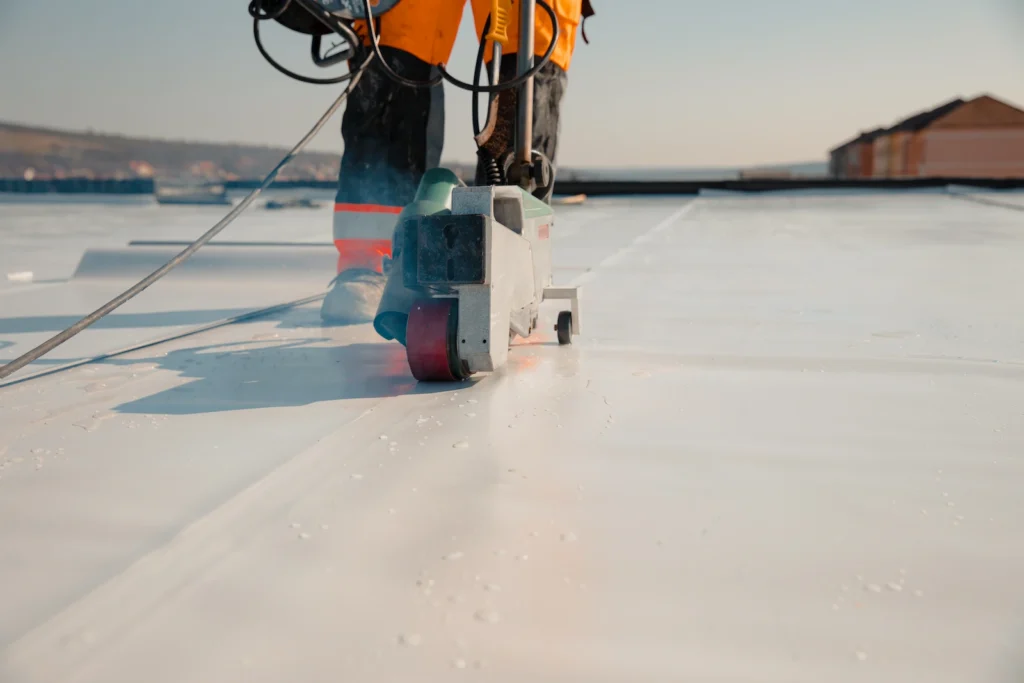
TPO and PVC are both thermoplastic membranes, which means adjoining sheets can be fused together using heat.
That creates welded seams rather than seams joined only by adhesives or tapes.
For commercial roofs, this matters because seams are common leak points. A properly welded seam helps create a strong, watertight connection between membrane sheets and reduces reliance on sealants that can degrade over time.
This is one reason both TPO and PVC remain popular in single-ply commercial roofing.
TPO vs PVC Cost
TPO is usually the lower-cost option.
For most commercial projects, TPO roofing typically costs $6 to $10 per square foot installed, while PVC roofing commonly ranges from $7 to $12 per square foot installed.
PVC costs more because of its formulation, chemical resistance, and specialized use cases. That higher price may not be necessary for a standard commercial building. But for roofs exposed to grease, oils, or harsh contaminants, the added cost may protect the building from premature membrane deterioration.
Which Buildings Are Better Suited for TPO?
TPO is often a practical fit for buildings where energy efficiency, budget control, and general commercial performance are the main priorities.
Common examples include:
- Warehouses
- Distribution centers
- Retail properties
- Office buildings
- Schools
- General commercial facilities
For these buildings, TPO often delivers strong value without paying for chemical resistance the roof may not need.
Which Buildings Are Better Suited for PVC?
PVC is often the better fit when the roof environment is more demanding.
Common examples include:
- Restaurants
- Commercial kitchens
- Food-processing facilities
- Manufacturing buildings
- Industrial plants
- Buildings with rooftop exhaust exposure
In these cases, membrane selection should account for what lands on the roof, not just what the roof looks like when installed.
PVC or TPO Roofing: How to Decide
Choose TPO when the goal is a cost-effective, reflective, single-ply roofing system for a standard commercial building.
Choose PVC when the building creates exposure risks that require stronger chemical resistance.
That is the cleanest way to compare the two systems.
If chemical exposure is not a major concern, TPO may be the better value. If grease, oils, or industrial contaminants are part of the roof environment, PVC may be the safer long-term investment.
Need Help Choosing Between TPO and PVC?
A roof specification should match the building’s real operating conditions.
Before choosing PVC or TPO roofing, have the roof evaluated for use, exposure, drainage, access, budget, and long-term maintenance needs.
Contact Show Me Coatings Today for a Free Professional Commercial Roof Inspection and Estimate.
Frequently Asked Questions About TPO and PVC Roofing
What is a plasticizer in PVC roofing?
A plasticizer is an additive used to help PVC membranes remain flexible. It is one of the formulation differences between PVC and TPO roofing systems.
Can TPO and PVC roofing be installed in cold weather?
Yes, but installation conditions matter. Temperature, wind, surface moisture, and manufacturer requirements can affect welding quality and installation timing.
Does rooftop grease affect roofing warranties?
It can. Grease exposure may affect warranty coverage if the roof membrane is not designed for that environment or if maintenance requirements are ignored.
Are TPO and PVC roofs compatible with solar panels?
Yes. Both systems can support commercial solar projects when structural capacity, attachment methods, and membrane protection are properly planned.
Can TPO or PVC roofing be repaired after puncture damage?
Yes. Punctures can often be repaired with compatible membrane patches and proper welding methods, depending on the size and condition of the damaged area.
Do TPO and PVC roofs need walkway pads?
Walkway pads are recommended around HVAC units, service paths, and high-traffic areas to reduce wear from maintenance crews and rooftop equipment access.
Can an older TPO or PVC roof be coated instead of replaced?
Sometimes. Coating eligibility depends on membrane condition, trapped moisture, adhesion testing, and whether the roof is still structurally sound.
The Right Choice Depends on Roof Exposure
TPO and PVC are both proven single-ply roofing systems, but they are built for different priorities.
TPO is often the better value for standard commercial roofs. PVC is often the better choice when chemical resistance is essential.
The best membrane is the one that fits the building’s use, exposure, and long-term performance goals.
Also Worth Reading
EPDM vs TPO Roofing: Which Membrane Is Better?
Ready to Choose the Right Single-Ply Roofing System?
Book Your Free Commercial Roof Assessment — Contact Show Me Coatings Today.
Show Me Coatings serves commercial and industrial property owners across Missouri and Iowa, specializing in roof coating, metal roof restoration, membrane restoration, and fabric-reinforced roofing systems. Office: 660-956-0141 | 24hr Emergency Line : 660-216-1932